
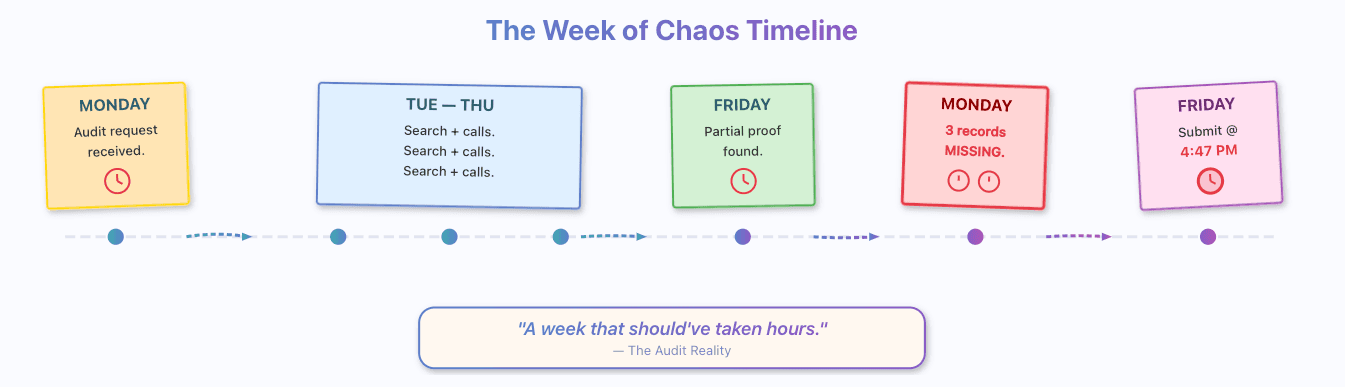
The DOI request arrived on Monday morning.
"Please provide documentation for all producer licenses, appointments, and E&O coverage for calendar year 2024. Response due by next Friday."
Your compliance lead starts pulling records. NIPR exports from quarterly downloads. Appointment confirmations buried in email. E&O certificates saved as PDFs with inconsistent file names.
Thursday is spent calling carriers to re-send old appointment letters.
By the following Monday, she's got most of it. But three producers have incomplete records—she knows they were compliant, but she can't find the proof.
Friday morning, she's still formatting everything into a coherent document.
You submit at 4:47 PM, exhausted, wondering if you missed something critical.
Why This Happens Every Time
The problem isn't that you weren't maintaining compliance—it's that you were maintaining it for operations, not for audits.
You tracked current status: who's licensed, who's appointed, who's covered. That's what you needed to run the business day-to-day.
But audits don't care about current status. They want historical proof with specific evidence: licenses active on specific dates, appointment letters with timestamps, E&O certificates showing continuous coverage with no gaps.
When an audit request comes in, you're not pulling a report—you're building one from scratch, reconstructing a timeline from fragments that were never designed to fit together.
This happens because most MGAs don't think about audits until they're being audited. And by then, you're in reactive mode: searching through old files, emailing carriers for confirmation letters you should have saved, explaining gaps in documentation that shouldn't exist.
The audit might conclude you were compliant, but the process revealed something worse—you couldn't prove it efficiently. That's an operational risk, not just an inconvenience.

What an Audit Binder Actually Is
An audit binder is a pre-assembled package of compliance evidence that answers every standard audit question before it's asked.
Think of it as a compliance snapshot: at any moment, you should be able to generate a complete record showing that every producer was properly licensed, appointed, and insured for every policy they wrote.
Here's what belongs inside:
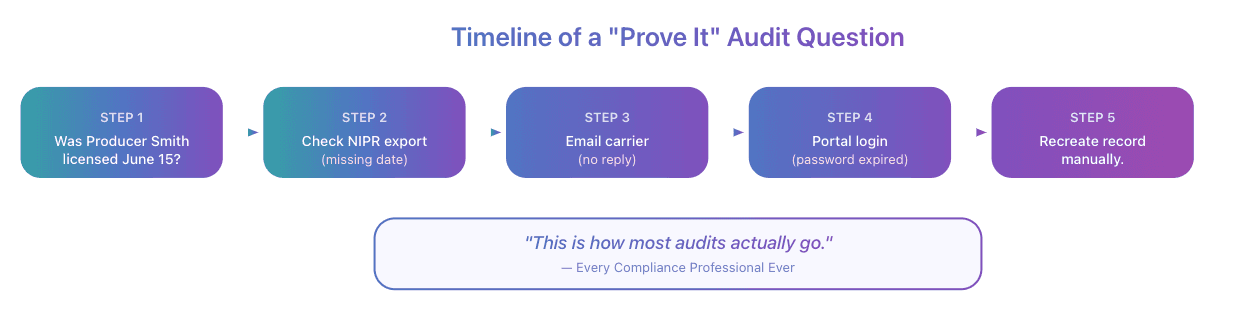
Producer licensing records — Not just current license status, but a historical log showing license issue dates, expiration dates, renewal confirmations, and status on specific dates. If an auditor asks "Was Producer Smith licensed in California on June 15, 2024?" you should be able to answer with a timestamped record, not a guess.
Carrier appointment documentation — Confirmation letters or portal screenshots showing when each appointment was activated—not submitted, activated. If a producer wrote business on March 10th, you need proof the appointment was live on March 9th or earlier.
E&O certificates — Current certificate plus historical certificates showing no coverage gaps. If your policy renewed mid-year, you need both the old and new cert to prove continuous coverage across the transition.
License application records — For new hires, documentation showing the application sequence—when submitted, when approved, what data was used. If a producer's license had a name discrepancy that was corrected, the audit trail should show the correction and when it was resolved.
CE compliance records — Completion certificates for every producer showing they met continuing education requirements before license renewal. Not just "they took the course"—proof they completed the right course for the right state before the deadline.
Termination documentation — For producers who left, proof that you notified carriers and canceled appointments within required timeframes. If someone left in April but you didn't notify the carrier until June, that's a gap auditors flag.
The common thread: everything is dated, everything has a source, and everything is exportable. You're not proving you're compliant—you're proving you can prove you're compliant.
What It Costs When You Don't Have One
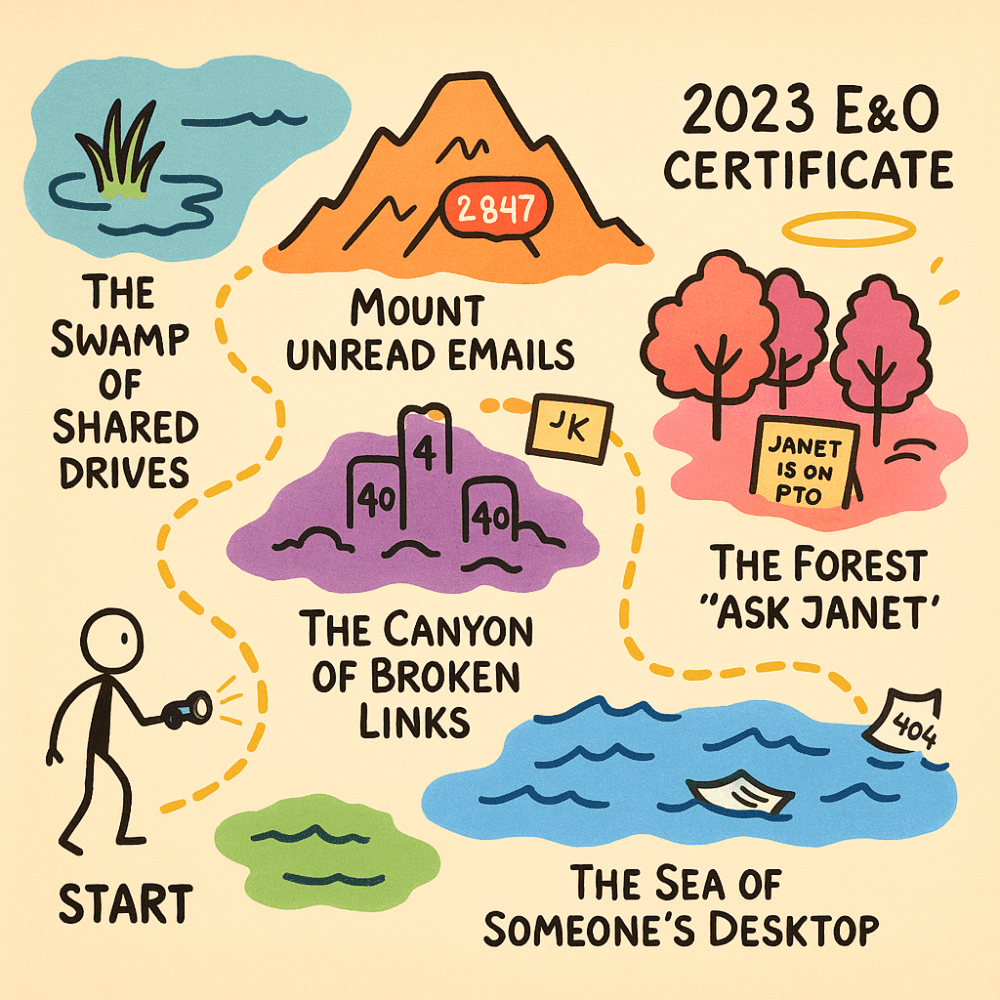
A routine carrier audit that should take two hours takes three days. A DOI audit that should be straightforward becomes a crisis.
Your compliance lead spends 20+ hours reconstructing records instead of doing actual compliance work. Current renewals slip while you're chasing historical documentation. Producers get frustrated waiting for appointment updates because your team is buried in audit response.
But the real cost is risk exposure. If you can't produce appointment documentation for a producer who wrote $500K in premium, the carrier can question whether those policies were properly authorized. If you can't prove E&O coverage was continuous, you're exposed on claims. If you miss responding to a DOI request because you're overwhelmed assembling records, penalties escalate.
The inability to produce documentation quickly isn't just inefficient—it creates liability.
How to Build One (Before You Need It)
The best time to build an audit binder is before someone asks for it. Here's the practical path:
Start with one producer. Pull together every document you'd need to prove their full compliance history—licenses, appointments, E&O, CE records. If you can't assemble it for one person, you can't do it for 80.
Identify the gaps. Where is documentation missing? Old appointment letters you didn't save? E&O certificates from two years ago? That's your audit debt. Start requiring that documentation moving forward, and backfill what you can.
Standardize file naming. If your E&O certificates are saved as "insurance.pdf" and "cert_2023_final_v2.pdf," you'll never find them during an audit. Use a consistent format: ProducerName_DocumentType_Date.pdf.
Automate evidence collection. Every time a license renews, save the confirmation. Every time an appointment activates, save the portal screenshot or confirmation email. Every time E&O renews, save the cert. This should be automatic, not someone's job to remember.
Generate a test binder quarterly. Pick five random producers and try to build their complete audit binder in under an hour. If you can't, you've found your documentation gaps before an auditor does.
Most MGAs realize they need this system somewhere between their second and third audit—when the pain of manual assembly finally outweighs the inertia of "we'll deal with it later." Purpose-built platforms like Producerflow treat the audit binder as a core feature, not an afterthought. Every compliance action generates an audit-ready artifact with immutable timestamps. When an audit request comes in, you export the binder—complete, formatted, sourced—in minutes, not days.

Your Turn
If a DOI auditor requested full documentation for your top ten producers right now, how long would it take you to produce it—and what would be missing?
Authors: Michelle Bothe & Ido Deutsch
About Producerflow
Producerflow is a modern platform designed to simplify producer management for insurance carriers, MGAs, and large agencies. By centralizing onboarding, compliance, licensing, and data integrations, Producerflow helps teams reduce operational friction, mitigate regulatory risk, and scale distribution with confidence.
Published
