
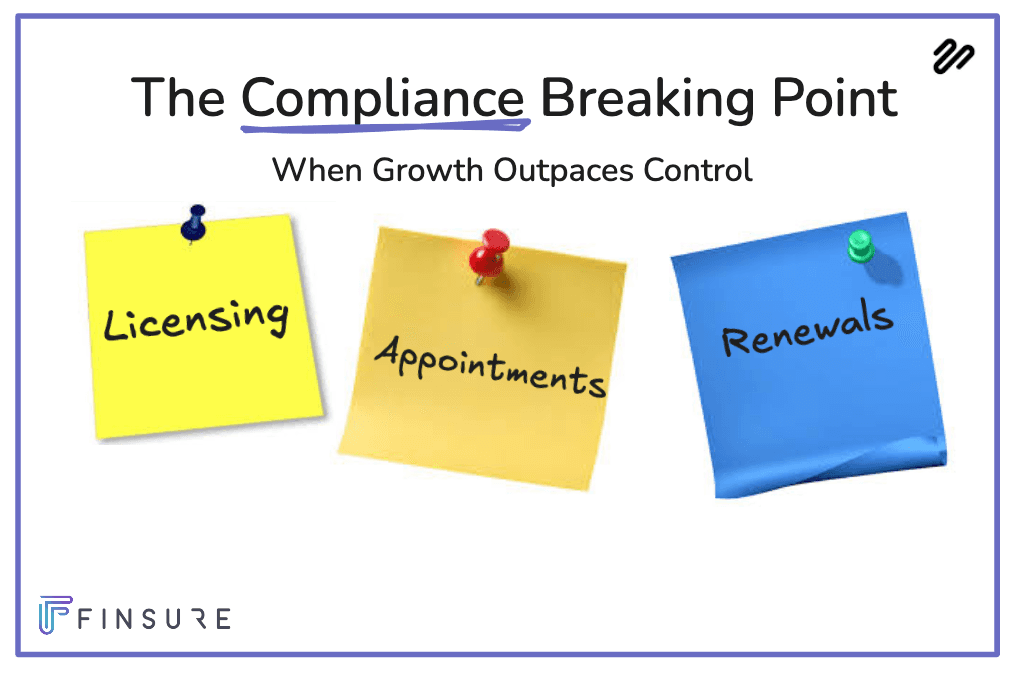
It usually happens around 50 producers.
Someone updates the license spreadsheet wrong. A carrier portal submission times out. An email with appointment confirmations sits unopened for three days. And suddenly half your team can't get appointed in a state you've been working in for years.
What used to take an afternoon now takes a week. What felt manageable now feels like chaos.
If you're reading this, you've either lived through this moment or you're about to.
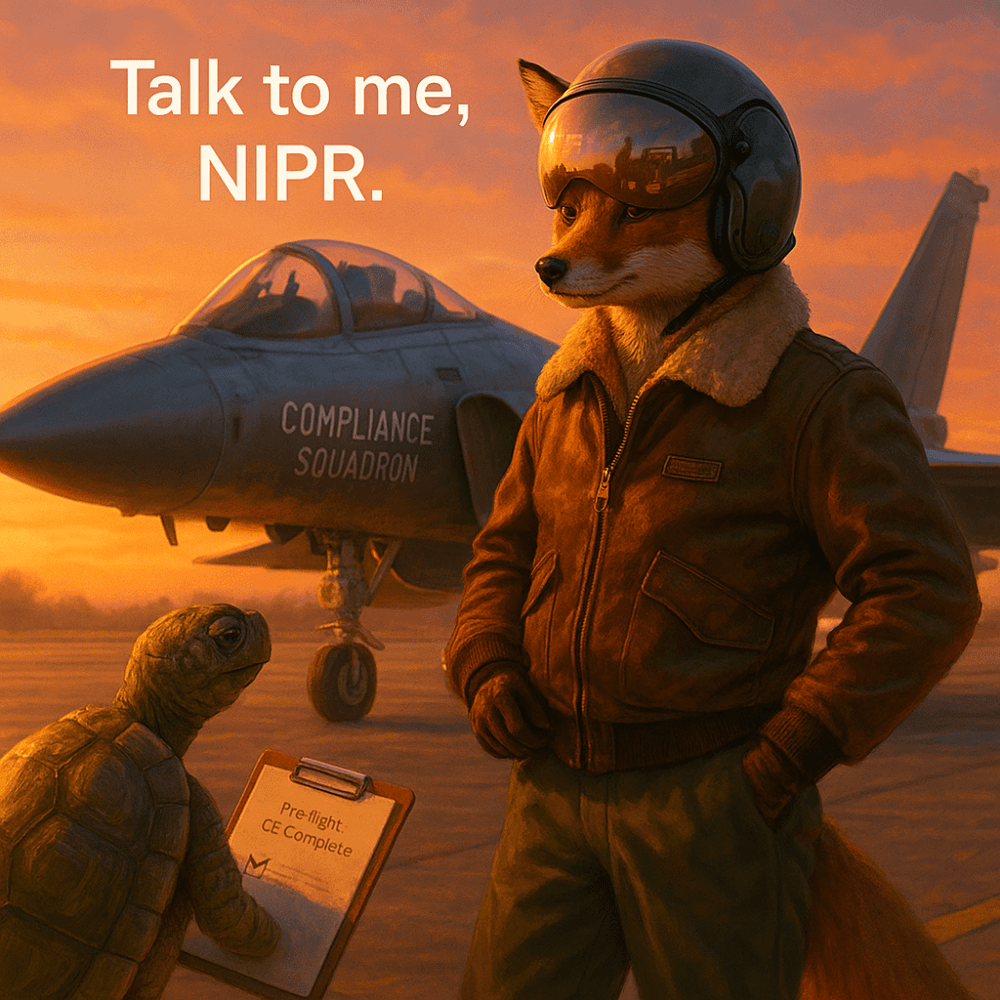
The System Is the Problem
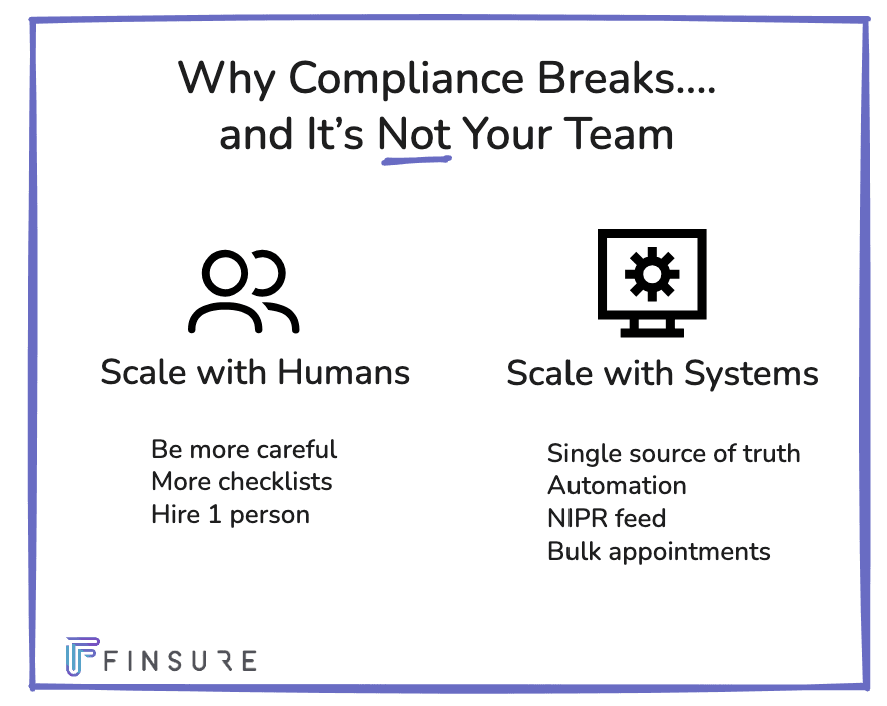
Here's what most people get wrong: they blame the team.
"We need better processes." "People need to be more careful." "We should hire someone to own this."
But the real problem isn't your people — it's that your compliance system was built for 15 producers, and now you're managing 75. Or 120. Or 200.
Every new producer adds:
Multiple state licenses to track
Carrier appointments to submit and monitor
Renewal dates that can't be missed
CE requirements that vary by state
Contract versions, background checks, E&O policies
The math is unforgiving. At 10 producers, you're tracking maybe 30 data points. At 100 producers? You're managing thousands of moving parts across 50 states and dozens of carriers.
Compliance scales linearly. Everything else — revenue, production, opportunity — scales exponentially.
That's the breaking point.
The Leadership Reframe
Most MGAs treat compliance as an administrative cost. Something you tolerate. A necessary evil you throw headcount at when things get messy.
But here's the shift: compliance could be viewed as a revenue throttle.
The faster you can activate a producer, the faster they can write business. The cleaner your compliance operation, the more carriers will trust you with capacity. The fewer missed renewals and appointments, the less revenue you lose to preventable downtime.
When an agency wants to join your network, how long does it take to get them fully appointed and writing? 45 days? 60 days? That's 1-2 months of lost production — per producer.
The real leadership moment is recognizing that fixing compliance isn't about "getting organized." It's about removing the bottleneck that's limiting your growth.
What You Can Do Now
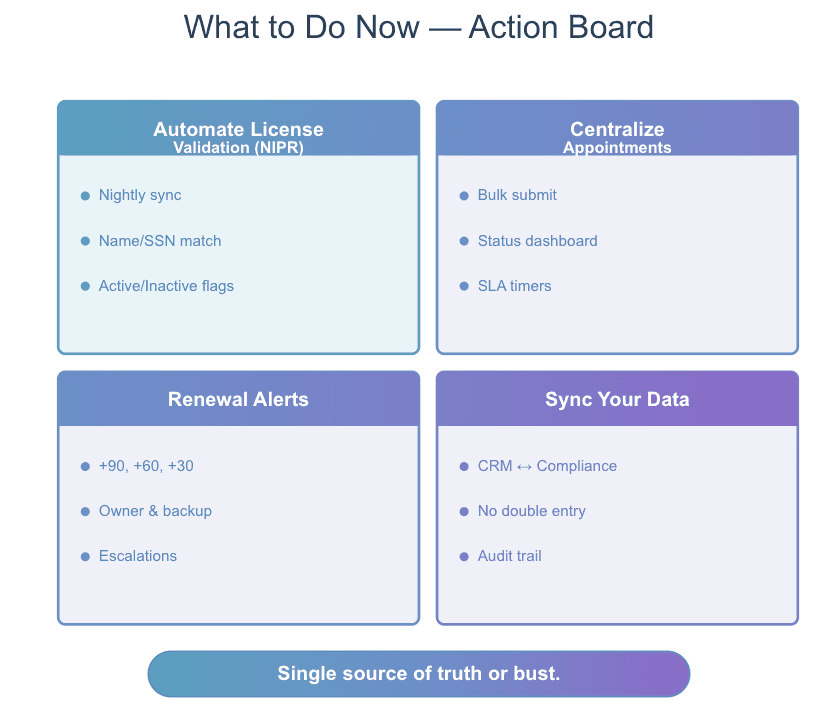
You don't need to fix everything overnight. But you do need to build for scale before you desperately need it.
Start with the biggest pain points:
Automate license validation — stop manually checking NIPR for every producer
Centralize appointment tracking — get out of carrier portals and into one system
Set up renewal alerts — 90-day warnings, not day-of panic
Sync your data — your CRM shouldn't contradict your compliance records
The principle is the same: eliminate manual handoffs and create a single source of truth. Most MGAs hit this point somewhere between 50-100 producers — which is why purpose-built platforms like ProducerFlow exist to handle license tracking, bulk appointment submissions, NIPR integration, and renewal monitoring automatically. Because at scale, automation stops being optional.
Your Turn
We want to hear from you: Where did your compliance process first start to crack?
Was it at 10 producers? 50? 100? What broke first — licensing, appointments, or something else entirely?
Authors: Michelle Bothe & Ido Deutsch
About Producerflow
Producerflow is a modern platform designed to simplify producer management for insurance carriers, MGAs, and large agencies. By centralizing onboarding, compliance, licensing, and data integrations, Producerflow helps teams reduce operational friction, mitigate regulatory risk, and scale distribution with confidence.
Published
